Ontario Job Posting Rules (2026): What You Can and Cannot Say
Summary
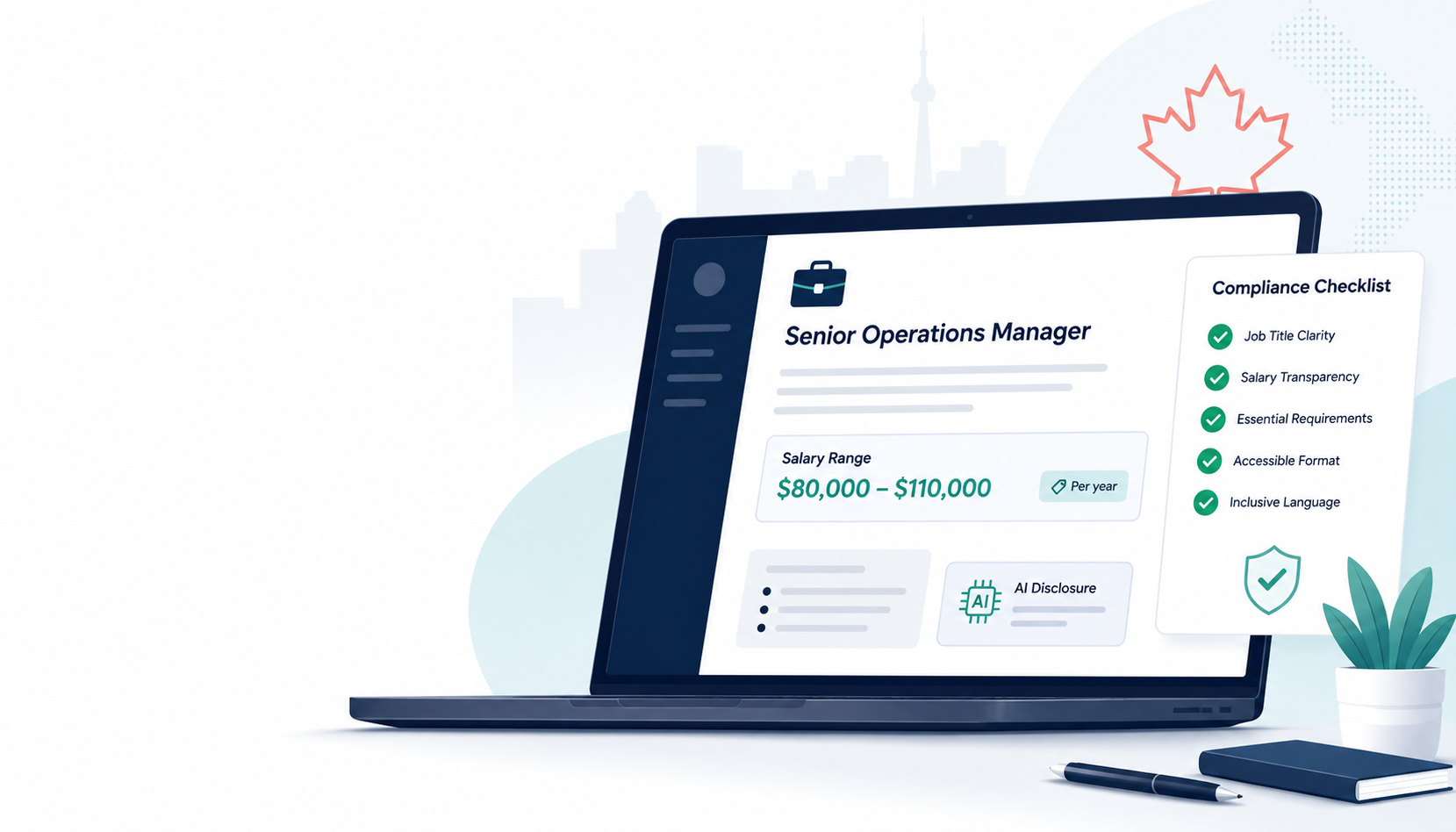
Since January 1, 2026, Ontario employers with 25 or more employees must meet six requirements on every publicly advertised job posting: disclose the expected pay, disclose any use of AI in hiring, state whether the vacancy is real, drop Canadian experience requirements, tell interviewed applicants the outcome within 45 days, and keep records for 3 years. These rules sit in the Employment Standards Act, 2000 and are enforced like any other employment standard, so a non-compliant ad is a live compliance risk, not a paperwork preference. For multi-location operators in retail, hospitality, and healthcare, the exposure multiplies across every open role. Getting the salary range and the AI disclosure right is where most employers slip.
- A posted salary range cannot span more than $50,000, and the rule does not apply where pay, or the top of the range, exceeds $200,000 per year.
- Requiring Canadian experience in a posting or on an application form is prohibited under the Employment Standards Act, 2000.
- Interviewed applicants must be told the hiring outcome within 45 days, and every posting must be kept on file for 3 years.
If you run a restaurant group, retail chain, care home, or franchise in Ontario with 25 or more employees, your job ads are now regulated. Ontario's job posting rules for 2026, in force since January 1, require every publicly advertised external posting to meet six separate requirements, covering salary disclosure, artificial intelligence, vacancy status, Canadian experience, applicant follow-up, and record keeping. Miss one across dozens of live postings and you expose the business to complaints, inspections, and enforcement under Ontario's employment standards regime. This guide breaks down all six rules in plain English, gives you compliant and non-compliant examples for each, lists the exemptions, and shows how to keep every posting on the right side of the law.
Which Ontario employers must follow the 2026 job posting rules?
Ontario's 2026 job posting rules apply to employers that have 25 or more employees on the day a posting is made, and only to publicly advertised external job postings. If you have fewer than 25 employees, or the posting is internal only, the rules do not apply.
The requirements sit in Part III.1 of the Employment Standards Act, 2000 (sections 8.1 to 8.6). They were introduced through the Working for Workers Four Act (2024), the Working for Workers Five Act (2024), and the Working for Workers Seven Act (2025), with the operating detail set out in O. Reg. 476/24 (Rules and Exemptions re Job Postings).
Count your employees on the day each posting goes live. A "publicly advertised" posting is one made available to the general public through a job board, your careers page, a recruiter, or social media. Postings limited to your current staff do not count.
The six Ontario job posting rules at a glance (2026)
The table below summarises what every covered Ontario job posting must do. Each rule is explained in full in the sections that follow.
Ontario pay transparency: must a job posting include a salary range?
Since January 1, 2026, every covered Ontario job posting must state the expected compensation for the role, either as a fixed amount or as a range, and a posted range cannot span more than $50,000 from minimum to maximum. The rule does not apply where the compensation, or the top of the range, is more than $200,000 per year.
"Compensation" here tracks the definition of wages under the Employment Standards Act, 2000, so it is broad. It excludes tips and other gratuities, discretionary bonuses that are not tied to performance, expense reimbursements, travel allowances, and employer contributions to benefit plans.
What this means for your ad: vague phrases like "competitive salary" or "pay based on experience" no longer meet the rule. You need a real number or a real range, and the range has to be tight.
Compliant example: "Line cook, $18.00 to $22.00 per hour."
Non-compliant example: "Assistant manager, $60,000 to $130,000." That spread is $70,000, which exceeds the $50,000 limit.
Worked example: is your salary range compliant?
- Take the minimum and maximum of your posted range. Say you want to post $65,000 to $120,000.
- Subtract the minimum from the maximum: $120,000 minus $65,000 = $55,000.
- Compare the spread to the $50,000 limit. $55,000 is more than $50,000, so this posting is not compliant.
- Narrow the range so the spread is $50,000 or less. For example, $70,000 to $120,000 gives a $50,000 spread and complies.
Ontario AI disclosure rules for job postings
If you use artificial intelligence to screen, assess, or select applicants for a publicly advertised Ontario job posting, the posting must disclose that AI is used in the hiring process. The disclosure has been required since January 1, 2026.
This covers the common tools many operators already use: resume parsers that rank applicants, chatbots that pre-screen, and any automated system that scores or shortlists candidates.
What this means for your ad: if a tool touches the screening or selection of applicants, add a short, plain line saying so. You do not need to explain how the tool works.
Compliant example: "We use automated tools, including AI, to review and screen applications for this role."
Non-compliant example: a posting that runs every applicant through an AI shortlisting tool but says nothing about it.
Must an Ontario job posting say whether the vacancy is real?
Every covered Ontario job posting must state whether it is for an existing vacancy, under section 8.5 of the Employment Standards Act, 2000. This stops the practice of advertising roles that do not exist purely to collect resumes.
What this means for your ad: if you are filling a real open role, say so. If you are building a candidate bank for future hiring with no current opening, the posting has to make that clear.
Compliant example: "This posting is for an existing vacancy."
Non-compliant example: a year-round "always hiring servers" ad that gives no indication of whether a real role is open.
Ontario's ban on Canadian experience requirements in job ads
Ontario employers can no longer require Canadian experience in a publicly advertised job posting or on any associated application form, under section 8.3 of the Employment Standards Act, 2000. The ban came out of a policy push to open hiring to newcomers and ease labour shortages, and it has applied since January 1, 2026.
What this means for your ad: you can still ask for relevant skills and a number of years of experience. You cannot specify that the experience must have been gained in Canada, and you cannot bury that requirement in the application form.
Compliant example: "3 years of experience in a high-volume kitchen."
Non-compliant example: "Must have 3 years of Canadian kitchen experience."
Ontario's 45-day applicant notification rule (no ghosting)
Ontario employers must tell every applicant they interview whether a hiring decision has been made, within 45 days of the interview. The requirement applies to covered employers as of January 1, 2026.
You can deliver this notice in person, in writing, or through technology such as an email or an applicant tracking system. It only applies to people you actually interviewed, not to every applicant. A basic pre-screening contact does not count as an interview for this rule. The rule is triggered by a meeting, in person or by phone or video, where questions are asked and answered to assess the candidate's suitability, and where there is more than one interview, the 45 days run from the last one.
What this means for your hiring: build a step into your process that closes the loop with interviewees inside the 45-day window. For a retail or hospitality operation interviewing dozens of candidates a month, this is easy to let slide, so automate the reminder.
Compliant example: emailing every interviewed candidate a clear "we have filled the role" or "we are moving forward with you" message within 45 days.
Non-compliant example: interviewing five candidates, hiring one, and leaving the other four with no word.
Ontario job posting record retention: the 3-year rule
Ontario employers must keep a copy of every publicly advertised job posting and any associated application form, plus a record of the information given to interviewed applicants, for 3 years after the posting is taken down. This applies to covered employers from January 1, 2026.
What this means for your records: archiving cannot wait until an inspector asks. The clock starts when the posting comes down, so each closed role needs its ad, its application form, and proof you notified interviewees, all stored for three full years.
Compliant example: a folder for each closed posting containing the live ad, the application form, and the dated notices sent to interviewees.
Non-compliant example: deleting an expired posting from your job board with no saved copy.
Which Ontario job postings are exempt from the 2026 rules?
Several types of posting fall outside Ontario's 2026 job posting rules. The main exemptions are: employers with fewer than 25 employees; generic help-wanted notices that do not reference a specific position; internal postings made available only to existing employees; postings for work performed outside Ontario, unless that work is a continuation of work performed in Ontario; and general recruitment campaigns with no job-specific details.
For a mixed role, where some duties are in Ontario and some are not, the out-of-province portion does not on its own take the posting out of scope. When in doubt about an Ontario-based role, treat it as covered.
What happens if your Ontario job posting is not compliant?
A non-compliant Ontario job posting is enforced under the Employment Standards Act, 2000 through the standard complaints and inspections process. That can lead to investigations, compliance orders, and penalties, on top of the reputational damage of a public ad that breaks the law.
Because the rules apply to every covered posting individually, each non-compliant ad is a separate point of exposure. An operator running 40 open roles across several locations is not making one mistake, but potentially 40.
How to check every Ontario job posting for compliance automatically
Manual auditing does not scale once you are posting at volume. Six rules, real penalties, and dozens of live ads across multiple locations make it easy to let one slip, usually the salary range spread or the AI disclosure. Checking each posting by hand before it goes live, every time, is exactly the kind of task that gets skipped under pressure.
Workforce.com lets you build plain-language rules that scan job ads for compliance, so each posting is checked against each requirement before it is published. Instead of trusting that a busy hiring manager remembered all six rules, the scanner flags the gap, for example a range that spreads past $50,000 or a missing AI disclosure, while the ad is still a draft.
Frequently asked questions about Ontario job posting rules in Canada
Stay compliant across every province with Workforce.com
The six Ontario rules are only part of the picture for operators who run locations in more than one province, where pay transparency, scheduling, and record-keeping obligations all differ. Workforce.com brings scheduling, payroll, and time and attendance onto one platform built for multi-province, shift-based businesses, so a restaurant group or retail chain can manage compliance across Ontario and beyond from a single system rather than juggling separate processes per location. Pair that with plain-language job-ad compliance checks, and every posting is screened before it goes live. Book a demo to see it on your own postings.
This information is for general purposes only and should not be considered legal advice. While we strive to keep it updated, laws and regulations can change at any time. It’s always a good idea to consult with a legal professional or relevant authorities to compliance with the most current standards.
Schedule, engage, and pay your staff in one system with Workforce.com.
Join over 52,000 of your HR peers
Enter your email below to subscribe to our newsletter.



You might also like

Ontario Statutory Holidays: Complete Employer Guide (2026)
A practical guide to Ontario's 9 statutory holidays for 2026, with confirmed dates, public holiday pay and premium pay rules, and worked examples for shift-based employers.

BC Statutory Holidays - Canada (2026)
A complete guide to British Columbia's 11 statutory holidays in 2026, including dates, eligibility rules, average day's pay calculations, and premium rates for employees who work.

Minimum Wage by Province - Canada (2026)
A complete breakdown of minimum wage rates across all 13 Canadian provinces and territories for 2026, including scheduled increases, effective dates, and special category rates.
Consolidate systems with Workforce.com
Get rid of multiple systems and manage HR, scheduling, and payroll in one place.